


Lab2PT — Conferences — Conferences
Conferences
"Journeys to the Ancient World" Lecture Series
In October 2025, the “Journeys to the Ancient World” Conference Cycle was inaugurated at the D. Diogo de Sousa Archaeological Museum, an event that will feature the participation of several invited speakers.
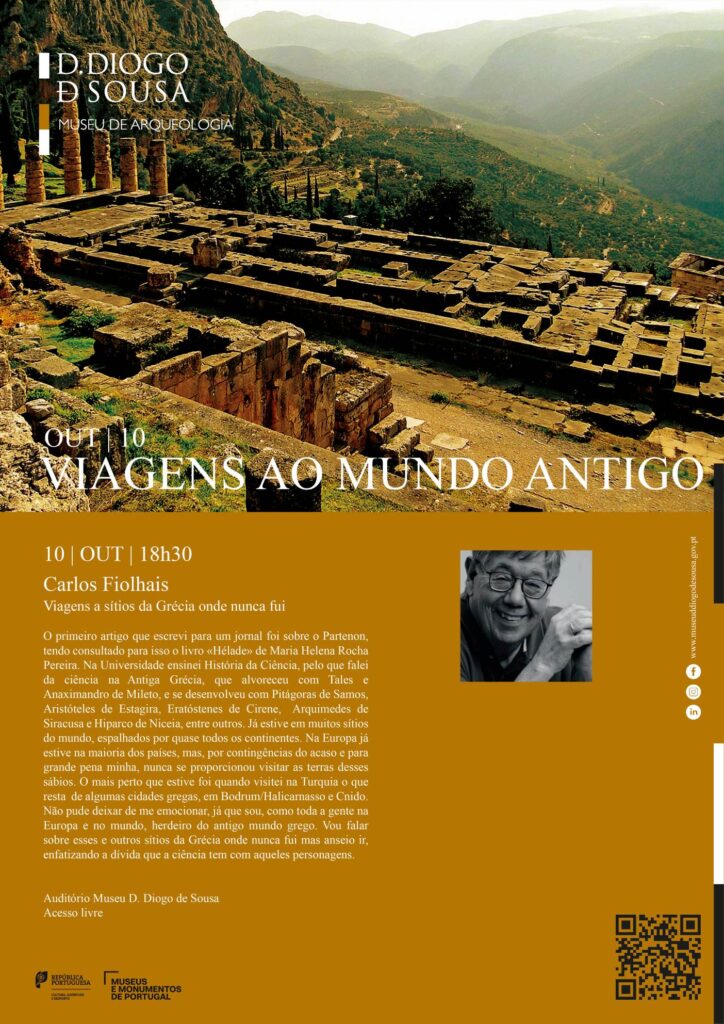
- On October 10, 2025, the first lecture in the series, entitled Journeys to places in Greece where I’ve never been” was given by Professor Carlos Fiolhais.
Synopsis:
One of my fondest memories from high school history classes was discovering Ancient Greece. The teacher would show us slides full of light and ruins. The first article I wrote for a newspaper was about the Parthenon, for which I consulted the book “Hélade” by Maria Helena Rocha Pereira. At university, I taught History of Science, so I spoke about science in Ancient Greece, which dawned with Thales and Anaximander of Miletus, and developed with Pythagoras of Samos, Aristotle of Stagira, Eratosthenes of Cyrene, Archimedes of Syracuse, and Hipparchus of Nicaea, among others. I have been to many places in the world, scattered across almost every continent. In Europe, I have been to most countries, but, due to chance and much to my regret, I never had the opportunity to visit the lands of these wise men. The closest I came was when I visited what remains of some Greek cities in Turkey, in Bodrum/Halicarnassus and Cnidus. I couldn’t help but get emotional, since I am, like everyone in Europe and the world, an heir to the ancient Greek world. I will talk about these and other sites in Greece that I have never been to but long to visit, emphasizing the debt that science owes to those people.
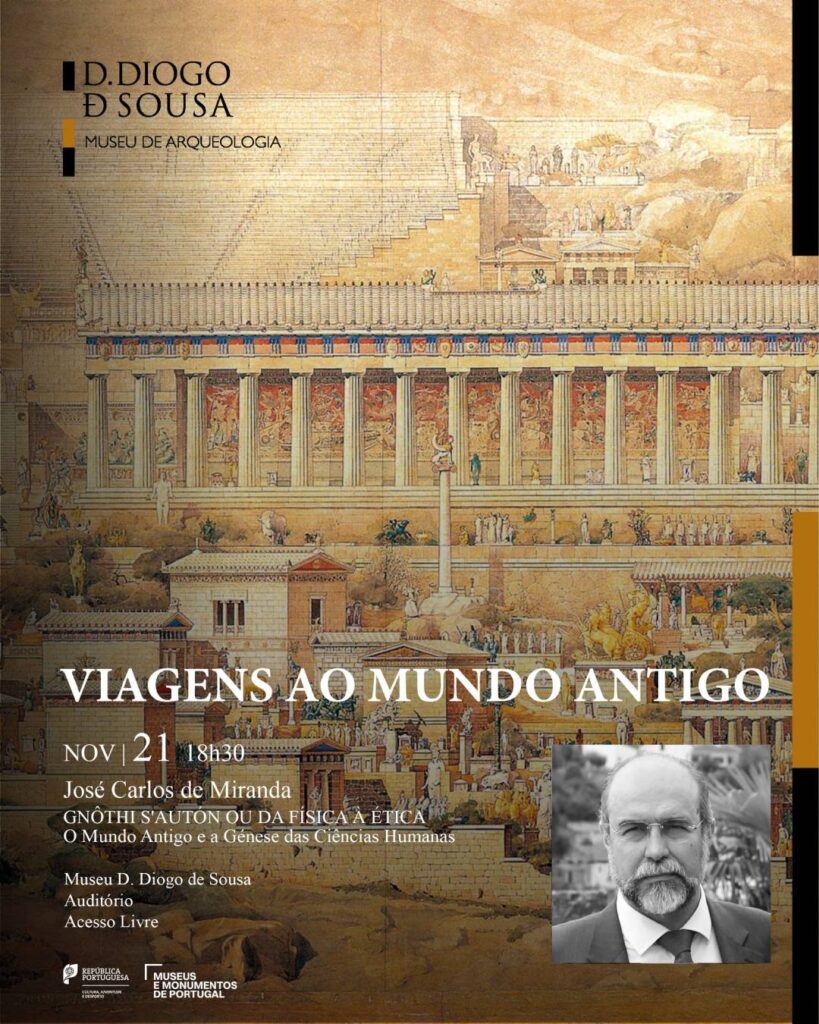
- On November 21, 2025, the next conference in the series was titled GNÔTHI S’AUTÓN OR FROM PHYSICS TO ETHICS – The Ancient World and the Genesis of the Human Sciences, and was given by Professor José Carlos de Miranda.
Synopsis:
Humanity has never existed without the mythical and symbolic thought developed in religions. And it continues to draw meaning from it to give to existence. But the mastery of the world afforded by science and technology that we enjoy today is due to the emergence of another kind of thought, logic, which was added to it around the 5th century BC. It is the thought that attempts to describe the world in terms of cause and effect. Its first exercise came to be called Philosophy, and the object that attracted its first practitioners, the “physicists,” was Nature (Physis). When this thought turned from the world to be known to the subject who knows it, a new Philosophy, Ethics, the matrix of all Human Sciences, was added to Physics, the matrix of all Natural Sciences. We will thus see how this classification, which continues to so profoundly structure Science and Education today, originates in the Ancient World.
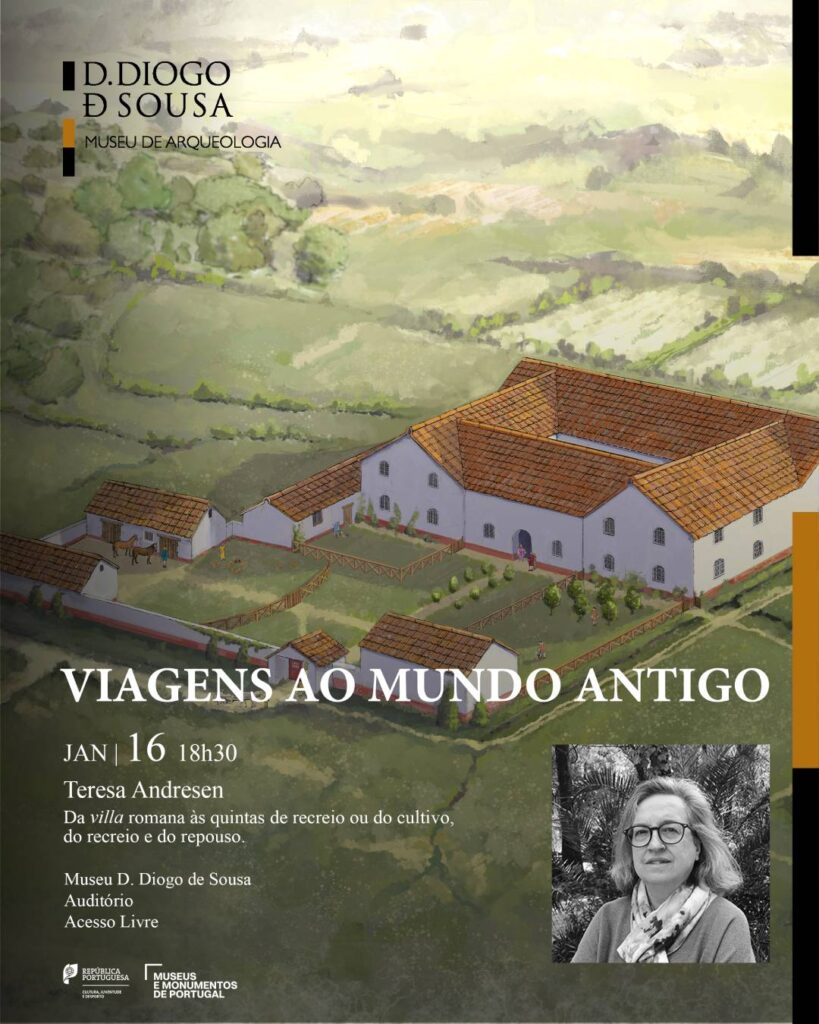
- On January 16, 2026 took place the third conference, From Roman villas to recreational or cultivated farms, for recreation and rest, given by Professor Teresa Andresen.
Synopsis:
To explore a typological continuity of ordered structures inscribed in the landscape as places of production and leisure, as a pretext for interpreting the cultural evolution of rural space and for questioning the challenges it faces today. From a productive and rational connection to the land—symbol of sustenance, order, and business, associated with refuge and distance, pleasure and contemplation, and leisure—to a disengagement from the land toward a new re-connection.
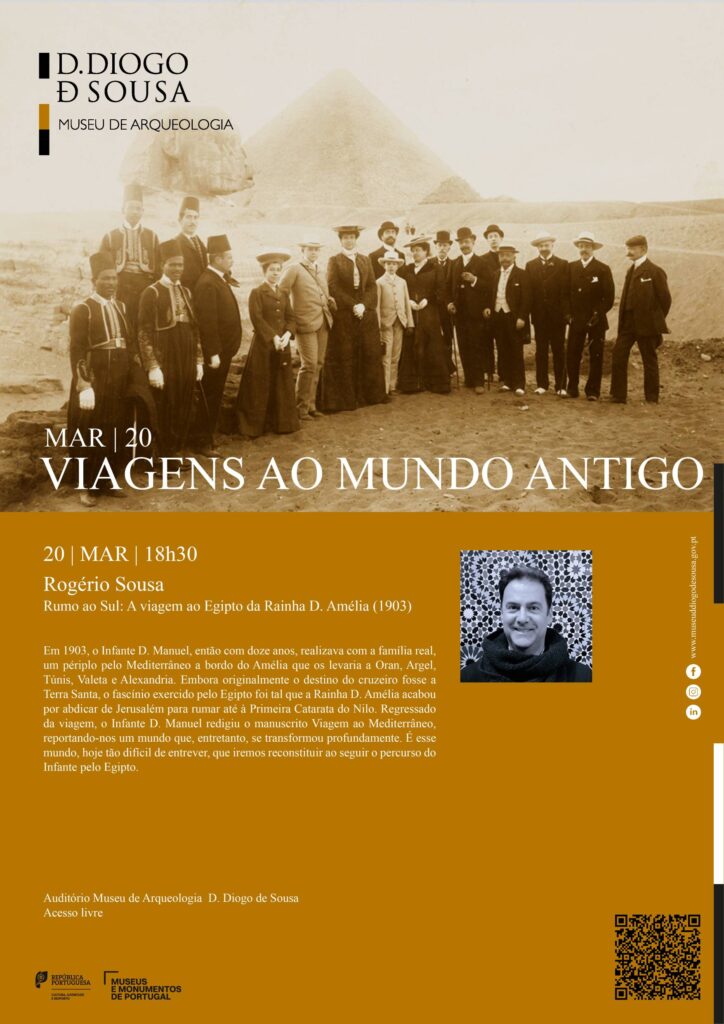
- On March 20, 2026, the fifth conference of the Journeys to the Ancient World Cycle took place, entitled Heading South: Queen D. Amélia’s Journey to Egypt (1903), given by Rogério Sousa (FLUL).
Synopsis:
In 1903, the Infante D. Manuel, then twelve years old, embarked with the royal family on a journey through the Mediterranean aboard the Amélia, which would take them to Oran, Algiers, Tunis, Valletta, and Alexandria. Although the original destination of the cruise was the Holy Land, the fascination exerted by Egypt was such that Queen D. Amélia ultimately abandoned the plan to visit Jerusalem in order to travel instead to the First Cataract of the Nile. Returned from the journey, Infante D. Manuel wrote the manuscript Journey to the Mediterranean, presenting to us a world that has since undergone profound transformation. It is this world—today so difficult to glimpse—that we will attempt to reconstruct by following the Infante’s route through Egypt.
- On April 24, 2026, the sixth conference of the Journeys to the Ancient World Cycle , will be entitled The Embrace of Saint Augustine – Jorge Oteiza’s Journey to the Colombian Andes, and will be given by María Teresa Muñoz.

Synopsis:
Jorge Oteiza traveled to South America between 1935 and 1949, living in various countries and, in 1944, he undertook an expedition to Alto Magdalena, Colombia. There he discovered the statuary of San Agustín, which inspired his research into the origin of art and the creative role of myths in human transformation. During this period, he distanced himself from sculptural practice to dedicate himself to theoretical reflection and the study of ancestral artistic expressions. This immersion in the Andean symbolic universe opened up a new field of research for him, decisive for the formulation of his aesthetics and for understanding art as a transformative force.
- The seventh lecture in the Journeys Through the Ancient World series, entitled “If the world were clear, art would not exist,” will be given on May 31, 2026, by conductor Martim Sousa Tavares.

Synopsis:
Martim Fernandes will take us on a journey through art and beauty, exploring its multiple meanings and our place in the world.
A proposal for everyone interested in culture, history, and critical thinking.
- On June 19, 2026, the eighth conference in the Journeys Through the Ancient World series will be titled From the Asklepeion to the present day: how the brain deceives us!, and will be given by João Cerqueira.

Synopsis:
Since written records began, there have been accounts of spiritual possessions, miraculous healings, and other phenomena that still occur and amaze us today. Their persistence and importance in very diverse civilizations and throughout human history leads us to believe that underlying such phenomena is likely a common biological basis. Starting with accounts of healings in the “Asklepeion” of ancient Greece, we will explore how the brain “plays tricks on us” and how this knowledge can help us understand some inexplicable phenomena that continue to occur… and surprise us.
- On September 12, 2026, the final conference of the first Journeys Through the Ancient World cycle will feature Rui Tavares (historian and politician) as the speaker, in a session entitled “The Three Wishes of the Historian: On Memory, Imagination, and Courage!”.

Synopsis:
Using a mosaic from the D. Diogo de Sousa Museum as an example, the historian invites us on a journey that traverses the ancient world, the narratives of One Thousand and One Nights, and the challenges of artificial intelligence, reflecting on how the past can help us think about the future.
More information about the conference series: HERE
October, 10, 2025 November 25, 2025 January 16, 2026 February 27, 2026 March 20, 2026 April, 24, 2026 May 31, 2026 - 5.30 pm June 19, 2026 September 12, 2026 - 9.30 pm 6.30 pm
D. Diogo de Sousa Archaeological Museum
Ana Sofia Silva (EAAD/Lab2PT/IN2PAST)
